Transformer for Univariate Time Series Forecasting
In this notebook, we build a transformer using pytorch to forecast \(\sin\) function as a time series.
import dataclasses
import math

import lightning as L
import matplotlib.pyplot as plt
import numpy as np
import pandas as pd
import torch
from lightning.pytorch.callbacks.early_stopping import EarlyStopping
from torch import nn
from ts_dl_utils.datasets.pendulum import Pendulum, PendulumDataModule
from ts_dl_utils.evaluation.evaluator import Evaluator
from ts_dl_utils.naive_forecasters.last_observation import LastObservationForecaster
Data
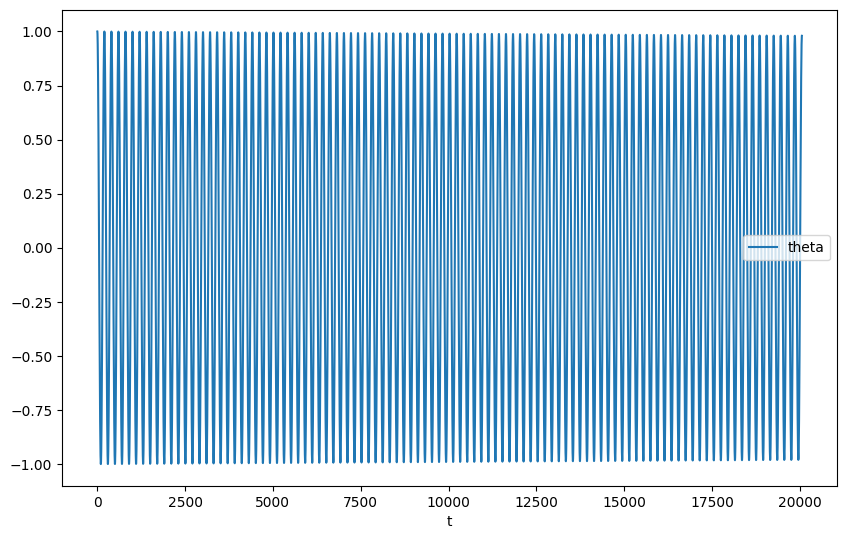
We create a dataset that models a damped pendulum. The pendulum is modelled as a damped harmonic oscillator, i.e.,
where \(\theta(t)\) is the angle of the pendulum at time \(t\). The period \(p\) is calculated using
with \(L\) being the length of the pendulum and \(g\) being the surface gravity.
pen = Pendulum(length=10000)
df = pd.DataFrame(pen(100, 400, initial_angle=1, beta=0.000001))
Since the damping constant is very small, the data generated is mostly a sin wave.
_, ax = plt.subplots(figsize=(10, 6.18))

df.plot(x="t", y="theta", ax=ax)
<Axes: xlabel='t'>
Model
In this section, we create the transformer model.
Since we do not deal with future covariates, we do not need a decoder. In this example, we build a simple transformer that only contains attention in encoder.
@dataclasses.dataclass
class TSTransformerParams:
    """A dataclass that contains all
    the parameters for the transformer model.
    """

    d_model: int = 512
    nhead: int = 8
    num_encoder_layers: int = 6
    dropout: int = 0.1


class PositionalEncoding(nn.Module):
    """Positional encoding to be added to
    input embedding.

    :param d_model: hidden dimension of the encoder
    :param dropout: rate of dropout
    :param max_len: maximum length of our positional
        encoder. The encoder can not encode sequence
        length longer than max_len.
    """

    def __init__(
        self,
        d_model: int,
        dropout: float = 0.1,
        max_len: int = 5000,
    ):
        super().__init__()
        self.max_len = max_len
        self.dropout = nn.Dropout(p=dropout)

        position = torch.arange(max_len).unsqueeze(1)
        div_term = torch.exp(
            torch.arange(0, d_model, 2) * (-math.log(10000.0) / d_model)
        )
        pe = torch.zeros(max_len, d_model)
        pe[:, 0::2] = torch.sin(position * div_term)
        pe[:, 1::2] = torch.cos(position * div_term)
        self.register_buffer("pe", pe)

    def forward(self, x: torch.Tensor) -> torch.Tensor:
        """
        :param x: input embedded time series,
            shape `[batch_size, seq_len, embedding_dim]`
        """
        history_length = x.size(1)
        x = x + self.pe[:history_length]

        return self.dropout(x)


class TSTransformer(nn.Module):
    """Transformer for univaraite time series modeling.

    :param history_length: the length of the input history.
    :param horizon: the number of steps to be forecasted.
    :param transformer_params: all the parameters.
    """

    def __init__(
        self,
        history_length: int,
        horizon: int,
        transformer_params: TSTransformerParams,
    ):
        super().__init__()
        self.transformer_params = transformer_params
        self.history_length = history_length
        self.horizon = horizon

        self.embedding = nn.Linear(1, self.transformer_params.d_model)

        self.positional_encoding = PositionalEncoding(
            d_model=self.transformer_params.d_model
        )

        encoder_layer = nn.TransformerEncoderLayer(
            d_model=self.transformer_params.d_model,
            nhead=self.transformer_params.nhead,
            batch_first=True,
        )
        self.encoder = nn.TransformerEncoder(
            encoder_layer, num_layers=self.transformer_params.num_encoder_layers
        )

        self.reverse_embedding = nn.Linear(self.transformer_params.d_model, 1)

        self.decoder = nn.Linear(self.history_length, self.horizon)

    @property
    def transformer_config(self) -> dict:
        """all the param in dict format"""
        return dataclasses.asdict(self.transformer_params)

    def forward(self, x: torch.Tensor) -> torch.Tensor:
        """
        :param x: input historical time series,
            shape `[batch_size, seq_len, n_var]`
        """
        x = self.embedding(x)
        x = self.positional_encoding(x)

        encoder_state = self.encoder(x)

        decoder_in = self.reverse_embedding(encoder_state).squeeze(-1)

        return self.decoder(decoder_in)
Training
We use lightning to train our model.
Training Utilities
history_length_1_step = 100
horizon_1_step = 1

gap = 0
We will build a few utilities
- To be able to feed the data into our model, we build a class (
DataFrameDataset) that converts the pandas dataframe into a Dataset for pytorch. - To make the lightning training code simpler, we will build a LightningDataModule (
PendulumDataModule) and a LightningModule (TransformerForecaster).
class TransformerForecaster(L.LightningModule):
    """Transformer forecasting training, validation,
    and prediction all collected in one class.

    :param transformer: pre-defined transformer model
    """

    def __init__(self, transformer: nn.Module):
        super().__init__()
        self.transformer = transformer
        self.save_hyperparameters()

    def configure_optimizers(self) -> torch.optim.Optimizer:
        optimizer = torch.optim.SGD(self.parameters(), lr=1e-3)

        return optimizer

    def training_step(self, batch: tuple[torch.Tensor], batch_idx: int) -> torch.Tensor:
        x, y = batch
        y = y.squeeze(-1).type(self.dtype)

        y_hat = self.transformer(x)

        loss = nn.functional.mse_loss(y_hat, y)
        self.log_dict({"train_loss": loss}, prog_bar=True)
        return loss

    def validation_step(
        self, batch: tuple[torch.Tensor], batch_idx: int
    ) -> torch.Tensor:
        x, y = batch
        y = y.squeeze(-1).type(self.dtype)

        y_hat = self.transformer(x)

        loss = nn.functional.mse_loss(y_hat, y)
        self.log_dict({"val_loss": loss}, prog_bar=True)

        return loss

    def predict_step(
        self, batch: list[torch.Tensor], batch_idx: int
    ) -> tuple[torch.Tensor]:
        x, y = batch
        y = y.squeeze(-1).type(self.dtype)

        y_hat = self.transformer(x)

        return x, y_hat

    def forward(self, x: torch.Tensor) -> tuple[torch.Tensor]:
        return x, self.transformer(x)
Data, Model and Training
DataModule
pdm_1_step = PendulumDataModule(
    history_length=history_length_1_step,
    horizon=horizon_1_step,
    dataframe=df[["theta"]],
    gap=gap,
)
LightningModule
ts_transformer_params_1_step = TSTransformerParams(
    d_model=192, nhead=6, num_encoder_layers=1
)

ts_transformer_1_step = TSTransformer(
    history_length=history_length_1_step,
    horizon=horizon_1_step,
    transformer_params=ts_transformer_params_1_step,
)

ts_transformer_1_step
TSTransformer(
  (embedding): Linear(in_features=1, out_features=192, bias=True)
  (positional_encoding): PositionalEncoding(
    (dropout): Dropout(p=0.1, inplace=False)
  )
  (encoder): TransformerEncoder(
    (layers): ModuleList(
      (0): TransformerEncoderLayer(
        (self_attn): MultiheadAttention(
          (out_proj): NonDynamicallyQuantizableLinear(in_features=192, out_features=192, bias=True)
        )
        (linear1): Linear(in_features=192, out_features=2048, bias=True)
        (dropout): Dropout(p=0.1, inplace=False)
        (linear2): Linear(in_features=2048, out_features=192, bias=True)
        (norm1): LayerNorm((192,), eps=1e-05, elementwise_affine=True)
        (norm2): LayerNorm((192,), eps=1e-05, elementwise_affine=True)
        (dropout1): Dropout(p=0.1, inplace=False)
        (dropout2): Dropout(p=0.1, inplace=False)
      )
    )
  )
  (reverse_embedding): Linear(in_features=192, out_features=1, bias=True)
  (decoder): Linear(in_features=100, out_features=1, bias=True)
)
transformer_forecaster_1_step = TransformerForecaster(transformer=ts_transformer_1_step)

transformer_forecaster_1_step
TransformerForecaster(
  (transformer): TSTransformer(
    (embedding): Linear(in_features=1, out_features=192, bias=True)
    (positional_encoding): PositionalEncoding(
      (dropout): Dropout(p=0.1, inplace=False)
    )
    (encoder): TransformerEncoder(
      (layers): ModuleList(
        (0): TransformerEncoderLayer(
          (self_attn): MultiheadAttention(
            (out_proj): NonDynamicallyQuantizableLinear(in_features=192, out_features=192, bias=True)
          )
          (linear1): Linear(in_features=192, out_features=2048, bias=True)
          (dropout): Dropout(p=0.1, inplace=False)
          (linear2): Linear(in_features=2048, out_features=192, bias=True)
          (norm1): LayerNorm((192,), eps=1e-05, elementwise_affine=True)
          (norm2): LayerNorm((192,), eps=1e-05, elementwise_affine=True)
          (dropout1): Dropout(p=0.1, inplace=False)
          (dropout2): Dropout(p=0.1, inplace=False)
        )
      )
    )
    (reverse_embedding): Linear(in_features=192, out_features=1, bias=True)
    (decoder): Linear(in_features=100, out_features=1, bias=True)
  )
)
Trainer
logger_1_step = L.pytorch.loggers.TensorBoardLogger(
    save_dir="lightning_logs", name="transformer_ts_1_step"
)


trainer_1_step = L.Trainer(
    precision="64",
    max_epochs=100,
    min_epochs=5,
    callbacks=[
        EarlyStopping(monitor="val_loss", mode="min", min_delta=1e-7, patience=3)
    ],
    logger=logger_1_step,
)
GPU available: True (mps), used: True
TPU available: False, using: 0 TPU cores
IPU available: False, using: 0 IPUs
HPU available: False, using: 0 HPUs
Fitting
demo_x = list(pdm_1_step.train_dataloader())[0][0].type(
    transformer_forecaster_1_step.dtype
)
demo_x.shape
torch.Size([32, 100, 1])
nn.Linear(
    1,
    ts_transformer_1_step.transformer_params.d_model,
    dtype=transformer_forecaster_1_step.dtype,
)(demo_x).shape
torch.Size([32, 100, 192])
ts_transformer_1_step.encoder(ts_transformer_1_step.embedding(demo_x)).shape
torch.Size([32, 100, 192])
trainer_1_step.fit(model=transformer_forecaster_1_step, datamodule=pdm_1_step)
Retrieving Predictions
predictions_1_step = trainer_1_step.predict(
    model=transformer_forecaster_1_step, datamodule=pdm_1_step
)
Naive Forecaster
trainer_naive_1_step = L.Trainer(precision="64")

lobs_forecaster_1_step = LastObservationForecaster(horizon=horizon_1_step)
lobs_1_step_predictions = trainer_naive_1_step.predict(
    model=lobs_forecaster_1_step, datamodule=pdm_1_step
)
Evaluations
evaluator_1_step = Evaluator(step=0)
fig, ax = plt.subplots(figsize=(50, 6.18))

ax.plot(
    evaluator_1_step.y_true(dataloader=pdm_1_step.predict_dataloader()),
    "g-",
    label="truth",
)

ax.plot(evaluator_1_step.y(predictions_1_step), "r--", label="predictions")

ax.plot(evaluator_1_step.y(lobs_1_step_predictions), "b-.", label="naive predictions")

plt.legend()
fig, ax = plt.subplots(figsize=(10, 6.18))

inspection_slice_length = 200

ax.plot(
    evaluator_1_step.y_true(dataloader=pdm_1_step.predict_dataloader())[
        :inspection_slice_length
    ],
    "g-",
    label="truth",
)

ax.plot(
    evaluator_1_step.y(predictions_1_step)[:inspection_slice_length],
    "r--",
    label="predictions",
)

ax.plot(
    evaluator_1_step.y(lobs_1_step_predictions)[:inspection_slice_length],
    "b-.",
    label="naive predictions",
)

plt.legend()
To quantify the results, we compute a few metrics.
pd.merge(
    evaluator_1_step.metrics(predictions_1_step, pdm_1_step.predict_dataloader()),
    evaluator_1_step.metrics(lobs_1_step_predictions, pdm_1_step.predict_dataloader()),
    how="left",
    left_index=True,
    right_index=True,
    suffixes=["_transformer", "_naive"],
)
Here SMAPE is better because of better forecasts for larger values
Forecasting (horizon=3)
Train a Model
history_length_m_step = 100
horizon_m_step = 3
pdm_m_step = PendulumDataModule(
    history_length=history_length_m_step,
    horizon=horizon_m_step,
    dataframe=df[["theta"]],
    gap=gap,
)
ts_transformer_params_m_step = TSTransformerParams(
    d_model=192, nhead=6, num_encoder_layers=1
)

ts_transformer_m_step = TSTransformer(
    history_length=history_length_m_step,
    horizon=horizon_m_step,
    transformer_params=ts_transformer_params_m_step,
)

ts_transformer_m_step
transformer_forecaster_m_step = TransformerForecaster(transformer=ts_transformer_m_step)
logger_m_step = L.pytorch.loggers.TensorBoardLogger(
    save_dir="lightning_logs", name="transformer_ts_m_step"
)


trainer_m_step = L.Trainer(
    precision="64",
    max_epochs=100,
    min_epochs=5,
    callbacks=[
        EarlyStopping(monitor="val_loss", mode="min", min_delta=1e-7, patience=3)
    ],
    logger=logger_m_step,
)
trainer_m_step.fit(model=transformer_forecaster_m_step, datamodule=pdm_m_step)
predictions_m_step = trainer_m_step.predict(
    model=transformer_forecaster_m_step, datamodule=pdm_m_step
)
Naive Forecaster
trainer_naive_m_step = L.Trainer(precision="64")

lobs_forecaster_m_step = LastObservationForecaster(horizon=horizon_m_step)
lobs_m_step_predictions = trainer_naive_m_step.predict(
    model=lobs_forecaster_m_step, datamodule=pdm_m_step
)
Evaluations
evaluator_m_step = Evaluator(step=2, gap=gap)
fig, ax = plt.subplots(figsize=(10, 6.18))

ax.plot(
    evaluator_m_step.y_true(dataloader=pdm_m_step.predict_dataloader()),
    "g-",
    label="truth",
)

ax.plot(evaluator_m_step.y(predictions_m_step), "r--", label="predictions")

ax.plot(evaluator_m_step.y(lobs_m_step_predictions), "b-.", label="naive predictions")

plt.legend()
fig, ax = plt.subplots(figsize=(10, 6.18))


for i in np.arange(0, 1000, 120):
    evaluator_m_step.plot_one_sample(ax=ax, predictions=predictions_m_step, idx=i)
evaluator_m_step.metrics(predictions_m_step, pdm_m_step.predict_dataloader())
evaluator_m_step.metrics(lobs_m_step_predictions, pdm_m_step.predict_dataloader())
Investigations
We dive deeper into the intermediate results of the model.
from pathlib import Path

import pandas as pd
import plotly.express as px
from torch.utils.data import DataLoader
from ts_dl_utils.datasets.dataset import DataFrameDataset
load_from_checkpoint = (
    Path(
        # "lightning_logs/transformer_ts_1_step/version_9"
        "lightning_logs/transformer_ts_1_step/version_7"
    )
    / "checkpoints"
)

# load_from_checkpoint = Path(logger_1_step.log_dir) / "checkpoints"
load_from_checkpoint, logger_1_step.log_dir
list(load_from_checkpoint.iterdir())[0]
transformer_forecaster_1_step_re = TransformerForecaster.load_from_checkpoint(
    # load_from_checkpoint / "checkpoints/epoch=11-step=5495.ckpt"
    list(load_from_checkpoint.iterdir())[0]
)

transformer_forecaster_1_step_re
Visualize Embeddings of Intermediate Layers
def embedding_extractor(
    forecaster: TransformerForecaster, x: torch.Tensor
) -> tuple[torch.Tensor]:
    """compute the embeddings based on the input

    :param forecaster: the trained forecaster
    :param x: input historical time series,
    """
    forecaster.transformer.to(x.device)
    x_embedding = forecaster.transformer.embedding(
        x.type_as(forecaster.transformer.embedding.weight)
    )
    x_positional = forecaster.transformer.positional_encoding(x_embedding)

    encoder_state = forecaster.transformer.encoder(x_positional)

    reversed = forecaster.transformer.reverse_embedding(encoder_state).squeeze(-1)

    return x_embedding, x_positional, encoder_state, reversed
def create_embedding_dataframe(
    dr_result: torch.Tensor,
    n_batches: int,
    input_example: torch.Tensor,
    n_components: int,
) -> pd.DataFrame:

    dr_df = pd.DataFrame(
        dr_result.detach().numpy(), columns=[f"DR_{i+1}" for i in range(n_components)]
    )

    dr_df["batch"] = sum(
        [[i] * (len(dr_df) // n_batches) for i in range(n_batches)], []
    )

    dr_df["sample_idx"] = list(range(len(dr_df) // n_batches)) * n_batches

    dr_df["input"] = np.concatenate(
        input_example[:n_batches].detach().numpy().astype("float32")
    )

    dr_df = dr_df.merge(
        pd.DataFrame(
            input_example[:n_batches].detach()[:, 0, 0].numpy(),
            columns=["batch_first_value"],
        )
        .reset_index()
        .rename(columns={"index": "batch"}),
        how="left",
        on="batch",
    )

    return dr_df
Prepare input data for embedding visualization.
investigation_dl = DataLoader(
    dataset=DataFrameDataset(
        dataframe=df[["theta"]],
        history_length=history_length_1_step,
        horizon=horizon_1_step,
        gap=gap,
    ),
    batch_size=400,
    shuffle=False,
)

investigation_dl
input_example = list(investigation_dl)[0][0]
input_example.shape
(embedding_example, positional_example, encoder_example, reversed_example) = (
    embedding_extractor(transformer_forecaster_1_step, input_example)
)
(
    input_example.shape,
    embedding_example.shape,
    positional_example.shape,
    encoder_example.shape,
    reversed_example.shape,
)
n_batches, seq_len, _ = input_example.shape
df_example = pd.DataFrame(
    {
        "input": input_example.squeeze(-1).detach().cpu().numpy().reshape(-1),
        "reversed": reversed_example.detach().cpu().numpy().reshape(-1),
        "sample": np.repeat(np.arange(n_batches), seq_len),
    }
)
df_example
px.scatter(
    df_example, x="input", y="reversed", color="sample", height=600, width=600
).update_layout(yaxis_scaleanchor="x")
import numpy as np
from torchdr import PCA, TSNE, UMAP
Latent space visualization
n_components = 2

dr_reversed_result = TSNE(
    # dr_reversed_result = UMAP(
    # dr_reversed_result = PCA(
    # n_neighbors=30,
    # backend='torch',
    perplexity=30,
    n_components=n_components,
).fit_transform(
    np.concatenate(
        [
            input_example.squeeze(-1).numpy().astype("float32"),
            reversed_example.detach().numpy().astype("float32"),
        ],
        axis=0,
    )
)
dr_reversed_df = pd.DataFrame(
    dr_reversed_result, columns=[f"DR_{i+1}" for i in range(n_components)]
)
dr_reversed_df["type"] = ["input"] * (len(dr_reversed_df) // 2) + ["embedded"] * (
    len(dr_reversed_df) - len(dr_reversed_df) // 2
)
dr_reversed_df["sample_idx"] = list(range(len(dr_reversed_df) // 2)) + list(
    range(len(dr_reversed_df) // 2)
)
px.scatter(
    dr_reversed_df,
    x="DR_1",
    y="DR_2",
    # z="DR_3",
    color="sample_idx",
    # color="DR_4",
    symbol="type",
    title="Embedding of Input and Encoded Time Series",
    height=600,
    width=800,
).update_layout(legend=dict(itemsizing="constant", orientation="h", y=-0.2)).show()
px.scatter_3d(
    dr_reversed_df,
    x="DR_1",
    y="DR_2",
    z="DR_3",
    color="sample_idx",
    # color="DR_4",
    symbol="type",
    title="Embedding of Input and Encoded Time Series",
    height=600,
    width=800,
).update_layout(legend=dict(itemsizing="constant", orientation="h", y=-0.2)).show()
px.scatter_3d(
    dr_reversed_df.loc[dr_reversed_df["type"] == "embedded"],
    x="DR_1",
    y="DR_2",
    z="DR_3",
    color="sample_idx",
    # color="DR_4",
    symbol="type",
    title="Embedding of Input Time Series",
    height=600,
    width=800,
).update_layout(legend=dict(itemsizing="constant", orientation="h", y=-0.2)).show()
Embedding outout
embedding_example.detach()[0].shape, input_example.detach()[0].shape
embedding_result = UMAP(
    # embedding_result = TSNE(
    n_neighbors=30,
    backend="torch",
    # perplexity=30,
    n_components=n_components,
).fit_transform(
    # np.concatenate(
    #     embedding_example.detach().numpy().astype("float32")
    # )
    embedding_example.detach().reshape(-1, embedding_example.shape[-1])
)

embedding_result.shape
dr_embedding_df = create_embedding_dataframe(
    dr_result=embedding_result,
    n_batches=embedding_example.shape[0],
    input_example=input_example,
    n_components=n_components,
)
dr_embedding_df
px.scatter(
    dr_embedding_df,
    x="input",
    y="DR_1",
    # x='DR_1',
    # y='DR_2',
    # z='DR_3',
    # color='sample_idx',
    # symbol='type',
    # color="batch_first_value",
    # color="input",
    title="Dimension Reduction for Embedding of Input Time Series",
    height=600,
    width=800,
).update_layout(legend=dict(itemsizing="constant", orientation="h", y=-0.2)).show()
px.scatter_3d(
    dr_embedding_df,
    x="DR_1",
    y="DR_2",
    # z='DR_3',
    z="input",
    # color='sample_idx',
    # symbol='type',
    # color="batch",
    # color="batch_first_value",
    color="input",
    title="UMAP Embedding of Input Time Series",
    height=600,
    width=800,
).update_layout(legend=dict(itemsizing="constant", orientation="h", y=-0.2)).show()
px.scatter(
    pd.DataFrame(input_example.detach()[:, 0, :].numpy()).reset_index(),
    x="index",
    y=0,
    height=600,
    width=800,
)
Positional encoding output
positional_example_sample_size = 100
# positional_result = UMAP(
positional_result = TSNE(
    # n_neighbors=30, backend='torch',
    perplexity=30,
    n_components=n_components,
).fit_transform(
    positional_example.detach()[:positional_example_sample_size].reshape(
        -1, positional_example.shape[-1]
    )
)

positional_result.shape
dr_positional_df = create_embedding_dataframe(
    dr_result=positional_result,
    n_batches=positional_example_sample_size,
    input_example=input_example,
    n_components=n_components,
)
dr_positional_df = pd.DataFrame(
    positional_result.detach().numpy(),
    columns=[f"DR_{i+1}" for i in range(n_components)],
)

dr_positional_df["batch"] = sum(
    [
        [i] * (len(dr_positional_df) // positional_example_sample_size)
        for i in range(positional_example_sample_size)
    ],
    [],
)

dr_positional_df["sample_idx"] = (
    list(range(len(dr_positional_df) // positional_example_sample_size))
    * positional_example_sample_size
)

dr_positional_df["input"] = np.concatenate(
    input_example[:positional_example_sample_size].detach().numpy().astype("float32")
)

dr_positional_df = dr_positional_df.merge(
    pd.DataFrame(
        input_example[:positional_example_sample_size].detach()[:, 0, 0].numpy(),
        columns=["batch_first_value"],
    )
    .reset_index()
    .rename(columns={"index": "batch"}),
    how="left",
    on="batch",
)
dr_positional_df
px.scatter_3d(
    dr_positional_df,
    x="DR_1",
    y="DR_2",
    z="input",
    # color='sample_idx',
    # symbol='type',
    # color="batch",
    color="batch_first_value",
    title="UMAP Embedding of Positional Encoded Time Series",
    height=600,
    width=800,
).update_layout(legend=dict(itemsizing="constant", orientation="h", y=-0.2)).show()
px.scatter(
    dr_positional_df,
    x="DR_1",
    y="DR_2",
    # z='input',
    # symbol='type',
    color="batch",
    # color="input",
    # color="batch_first_value",
    title="UMAP Embedding of Positional Encoded Time Series",
    height=600,
    width=800,
).update_layout(legend=dict(itemsizing="constant", orientation="h", y=-0.2)).show()
px.scatter(
    dr_positional_df,
    x="input",
    y="DR_1",
    color="batch_first_value",
)
Encoder output
# encoder_result = TSNE(
encoder_result = PCA(
    # n_neighbors=30, backend='torch',
    # perplexity=30,
    n_components=n_components
).fit_transform(
    encoder_example.detach()[:positional_example_sample_size].reshape(
        -1, encoder_example.shape[-1]
    )
)

encoder_result.shape
dr_encoder_df = create_embedding_dataframe(
    dr_result=encoder_result,
    # n_batches=encoder_example.shape[0],
    n_batches=positional_example_sample_size,
    input_example=input_example,
    n_components=n_components,
)
px.scatter_3d(
    dr_encoder_df,
    x="DR_1",
    y="DR_2",
    z="input",
    # color='sample_idx',
    # symbol='type',
    # color="batch",
    color="batch_first_value",
    title="UMAP Embedding of Encoder Encoded Time Series",
    height=600,
    width=800,
).update_layout(legend=dict(itemsizing="constant", orientation="h", y=-0.2)).show()
px.scatter(
    dr_encoder_df,
    x="input",
    y="DR_1",
    color="batch_first_value",
)